
Saline County Arrest Records
Saline County arrest records and court charge records are related, but they are not the same record. The arrest side is created through law enforcement and jail booking. It can include the arrested person's name, booking number, booking date and time, visible charges or holds, bond amount, bond type, and release status when the person appears on the public roster. The court-charge side begins when the prosecutor files a complaint, information, or other charging document with the court clerk.
The Saline County current inmate roster is the local online source for public booking and charge fields after a person is booked into the Saline County Detention Center. The full criminal case file, including pleas, motions, disposition, sentencing, and probation entries, belongs with Saline County criminal court records. A court charge can change after filing, so a roster entry should not be treated as the final outcome.
The current inmate roster is the local booking-side source for Saline County arrest records.
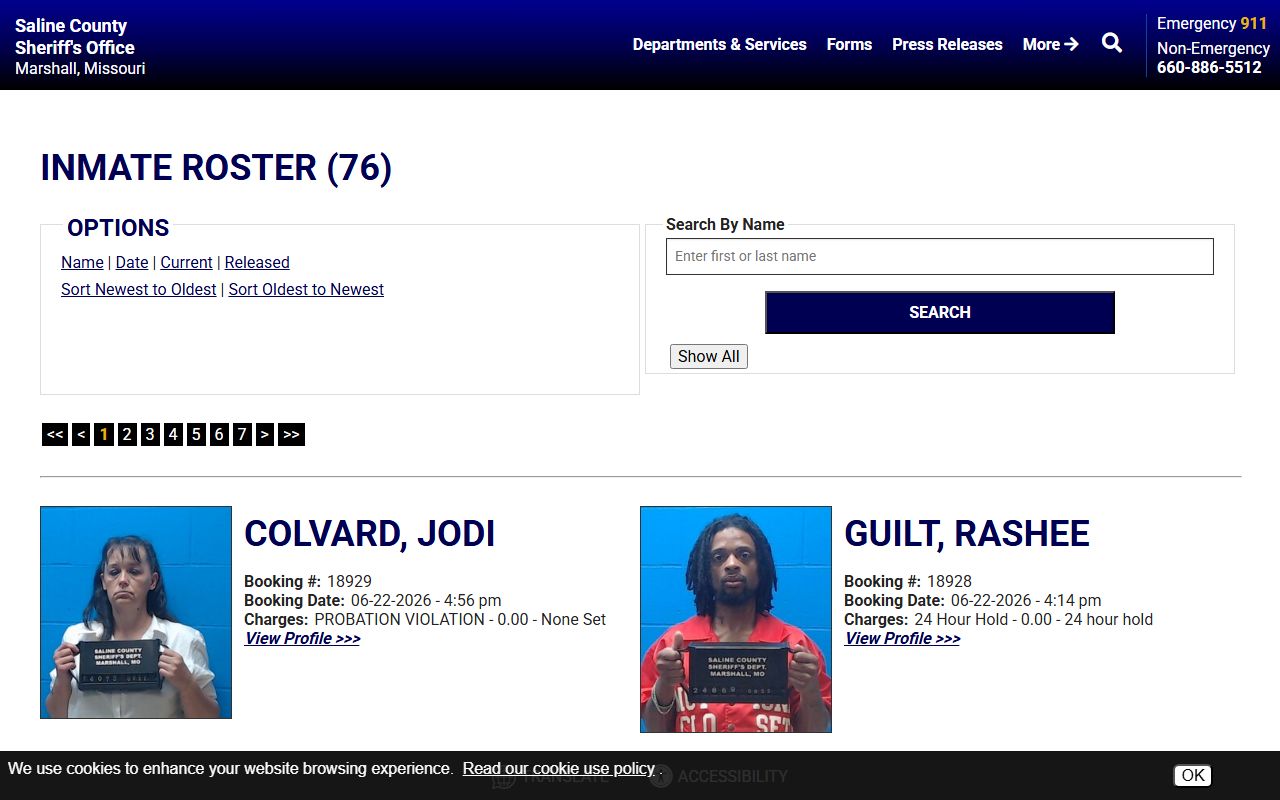
Roster fields can show charges and bonds soon after booking, while the court file later shows formal prosecution activity and case outcomes.
Search Saline Arrest Records
Use two channels for Saline County arrest records and court charges after arrest. First, search the sheriff roster for a current or recent booking. The roster landing page separates current inmates from 48-hour releases. Second, use Missouri Case.net to search the court case by defendant name, case number, filing date, or scheduled hearing. A person may appear on the jail roster before the court case is fully visible online, and a case may remain in Case.net after the person is released from jail.
The roster landing page shows the current-inmate and 48-hour-release paths.
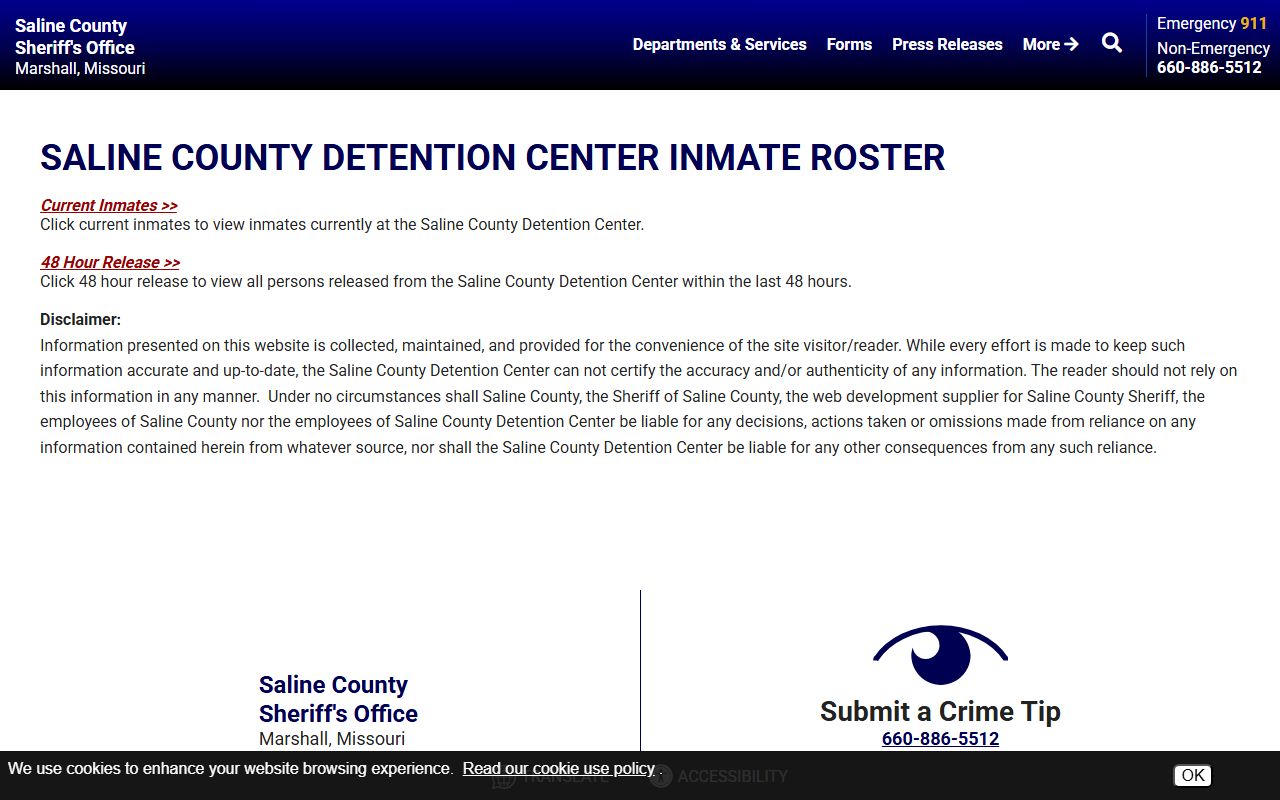
That split is useful because a person arrested and released quickly may no longer appear in the current-custody view.
- Open the Saline County Sheriff's roster and choose current inmates or the 48-hour release view.
- Search by name or sort by booking date to find a recent booking entry.
- Review the listed charges, bond amount, bond type, booking number, booking date, and profile link.
- Search Case.net by defendant name or case number to find the formal court charge record.
- Read each court charge for status, plea, disposition, sentence, and any later amendment or dismissal.
Charges After Arrest
Charges after arrest are filed by the prosecutor, not by the jail roster. The Saline County Prosecuting Attorney decides whether to prosecute or drop charges. A booking entry can reflect a hold or alleged offense, but the court charge record is built from the prosecutor's filing and the clerk's case record. Missouri criminal court records may include a complaint, information, warrant or summons, bond events, arraignment, pleas, docket entries, motions, orders, disposition, sentence, and probation entries.
| Complaint | Information | Indictment | |
|---|---|---|---|
| Filed By | Officer or prosecutor, depending on procedure. | Prosecutor. | Grand jury. |
| Common Use | Early charging document or lower-level case start. | Many Missouri criminal prosecutions. | Serious felony or grand-jury matters. |
| Record Role | Starts or supports the court allegation. | States the formal charge filed in court. | States a grand-jury accusation. |
| Later Events | May be amended or followed by another filing. | May be amended, dismissed, pled, or tried. | May proceed like other filed felony charges. |
Saline Charge Status
A charge status can change many times before a case is over. A charge may be pending at arraignment, amended after plea negotiations, reduced to a lesser charge, dismissed by the court, or dropped by the prosecutor. A disposition is the result of the charge. It is different from the charge description that appears at the start of the case.
| Status | What It Means |
|---|---|
| Pending | The charge remains open and has not reached final disposition. |
| Amended or Reduced | The filed charge changed, often by new wording, level, count, or plea agreement. |
| Dismissed | The charge was ended without conviction on that count. |
| Nolle Prosequi | The prosecutor declined to continue the charge, where that term appears in the record. |
| Guilty Plea or Verdict | The charge resulted in conviction and can move to sentencing. |
Note: One arrest can produce several charges, and each count can have a different status or outcome.
Saline Charge Record Fields
Public Saline County charge records can be read from both roster and court records, but the fields serve different purposes. The jail roster is a custody and booking view. Case.net is the court view. If the facts conflict, confirm the current court status with the Circuit Clerk or the assigned court record because charges may be updated after booking.
| Field | Where It Appears | What It Shows |
|---|---|---|
| Booking Number | Sheriff roster | Local booking identifier tied to jail custody. |
| Booking Date | Sheriff roster | Date and time the person entered the detention center. |
| Charge Description | Roster and court file | The alleged offense or hold language shown publicly. |
| Bond Amount | Roster and court file | Cash-only, no-bond, none-set, or other listed bond status when public. |
| Case Number | Case.net | Missouri court identifier for the formal case record. |
| Disposition | Case.net | Final result of the charge or case when entered. |
| Sentence | Case.net | Fine, costs, jail, prison, probation, restitution, or suspended terms if public. |
Charges vs Convictions
An arrest record or charge record does not prove guilt. It shows that a person was arrested, booked, held, or accused in court. A conviction is different. It occurs only after a guilty plea, verdict, or court finding. Saline County public records should be read with that distinction in mind, especially when a roster still shows an early charge that later changed in the court file.
| Charge | Conviction | |
|---|---|---|
| Stage | Accusation after arrest, summons, or prosecutor filing. | Final guilt finding by plea, verdict, or court decision. |
| Proof | Based on probable cause or prosecutor filing. | Requires guilt established through the criminal process. |
| Record Meaning | Can be pending, amended, reduced, or dismissed. | Can lead to sentence, probation, costs, and later post-judgment entries. |
| Use | Track accusation and case start. | Track final outcome and sentence. |
Saline Charge Filing Office
The Saline County Prosecuting Attorney is Tim Thompson. The office is in the Saline County Courthouse at 19 E. Arrow Street, Room 100, Marshall, MO 65340. Hours are Monday through Friday, 8:00 a.m. to 4:30 p.m. The phone is (660) 886-9608, fax is (660) 886-4884, and the listed email is thompson@salinecountymo.gov. The prosecutor represents government interests in criminal proceedings and decides whether to prosecute or drop charges.
Victim services can affect charge and sentencing records when restitution, notification, and final disposition are involved. The Saline victim advocate page identifies the V.O.I.C.E. program and lists rights tied to proceedings, final disposition, custody-release notifications, restitution, witness fees, and return of property not needed as evidence.
The victim advocate resource is assigned to Saline County arrest records and charge context because it explains the prosecution-side rights channel.
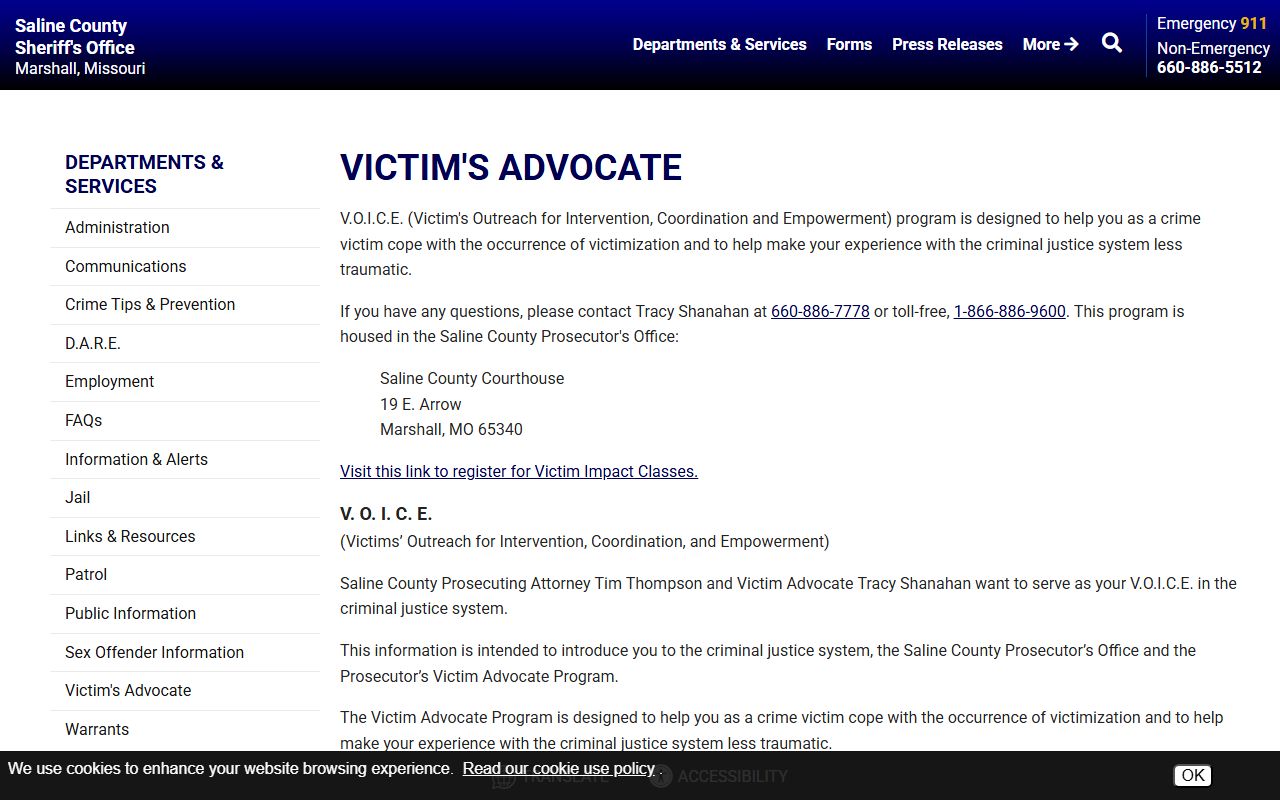
Victim-rights information does not decide a charge, but it can explain notices, restitution, and final-disposition events in the court record.
Closed Saline Charge Records
Missouri expungement can close eligible criminal arrests, charges, and convictions from general public access. RSMo 610.140 is the main expungement statute identified in the research. Saline County's filing-fee sheet lists expungements under sections 610.130 and 610.140 at $100.50. RSMo 610.120 explains that closed criminal records are not destroyed, but they are not open to the general public except for specified agencies and persons.
| Sealed or Closed | Expunged | |
|---|---|---|
| Visibility | Hidden from ordinary public search by law or court order. | Closed from public access after a successful petition. |
| Record Status | Still exists but is access-limited. | Still exists for limited statutory access. |
| Examples | Juvenile matters, sealed warrants, protected identifiers, sealed cases. | Eligible arrests, charges, or convictions under Missouri expungement law. |
Statewide Charge Lookups
Saline County court charges are local court records, but related state systems may help with other record types. The Missouri Department of Corrections offender search applies to sentenced state-prison offenders after transfer to DOC. VINELink provides custody notification and facility lookup. The Missouri State Highway Patrol handles some statewide criminal-justice public-record requests and the sex offender registry, but those systems are not substitutes for the Saline County court charge record.
Use the sheriff roster for local custody, Case.net for public court charges, the Circuit Clerk for official court copies, and the Sheriff's administration office for incident or offense reports that are not court filings. For active warrant checks, the Saline County Sheriff says warrant information is not given by phone and an in-person request is required.
Charge Lookup Limits
Arrest records, roster entries, charge records, and criminal case records should not be used as if they were the same thing. A booking record may be corrected, released, or replaced by a later court filing. A charge may be dismissed. A conviction may later be closed from general public access if the court grants expungement. Public access also excludes juvenile records, sealed matters, and protected personal information.
Important: Public arrest and charge lookups are not FCRA consumer reports and must be verified with official record custodians.
Restricted Saline Charge Records
Restricted charge records include juvenile charges, sealed charges, expunged records, sealed indictments, sealed warrants, active investigative information, and dismissed charges that have been closed by law. The public roster warns that jail information is provided for convenience and is not certified for accuracy or authenticity. Case.net may also omit records that are confidential, sealed, too new, entered under a different court location, or not public by rule.
When a charge status matters for court, employment licensing, bond, probation, or safety planning, use the originating source. The Circuit Clerk is the local court-record custodian. The Sheriff's Office handles booking and jail status. The Prosecuting Attorney controls charging decisions. Counsel or the public defender channel should be used for legal advice on pending criminal matters.